How to Choose the Best Digital Marketing Company in Hyderabad: 15 Things Most Agencies Won’t Tell You
☰ Table of Contents
- 1. Why Choosing an Agency Has Become So Hard
- 2. The Buyer's Journey: What to Evaluate at Each Step
- 3. What a Digital Marketing Company Actually Does
- 4. Why Businesses End Up Hiring the Wrong Agency
- 5. 15 Things Most Agencies Won't Tell You
- 6. Questions to Ask Before Hiring
- 7. Red Flags
- 8. Green Flags
- 9. Agency Evaluation Scorecard
- 10. What Digital Marketing Costs in Hyderabad
- 11. What Results Should You Actually Expect
- 12. Priorities by Industry (Hyderabad Context)
- 13. How DigitalGen Actually Works
- 14. Practical Examples: Real DigitalGen Work
- 15. Why Transparency Matters More Than Promises
- 16. How to Compare Two Agency Proposals
- 17. Evaluation & Discovery Call Checklists
- 18. Frequently Asked Questions
Search “best digital marketing company in Hyderabad,” “SEO company near me,” or “social media marketing agency” and you’ll get hundreds of results. Nearly every one claims to be “best,” “top rated,” or “award winning,” and more than a few promise guaranteed rankings or guaranteed leads. Choosing between them has become genuinely difficult, not because good agencies don’t exist, but because the claims all sound identical from the outside.
This guide is different in one specific way: it’s built to help you evaluate any agency, not just convince you to pick DigitalGen. Every figure below is linked to its original, official source. If you finish this and still choose someone else, that’s a fine outcome, as long as you’re choosing with your eyes open.
1. Why Choosing an Agency Has Become So Hard
Every agency website looks confident. Every agency claims measurable results. The problem is that “measurable” and “meaningful” aren’t the same thing, an agency can show you a graph of rising followers or impressions while your actual enquiries stay flat. Digital marketing genuinely combines several distinct disciplines, technical SEO, paid media buying, content strategy, design, analytics, each with its own way of misleading a non-expert.
Why People Actually Start Looking
Nobody searches “digital marketing company in Hyderabad” out of idle curiosity. Usually something specific has already gone wrong: sales have quietly dropped, a competitor has started outranking you on Google, referrals that used to arrive on their own have dried up, or an earlier agency was paid for months with nothing meaningful to show for it. Underneath all of that is usually one real question: who can I actually trust with this?
A Hyderabad Example, Not a Hypothetical One
Consider a common pattern seen across small businesses in the city: a restaurant owner in Kukatpally picks the cheapest agency they can find, one promising 30 posts a month, SEO, Google Ads, and full website maintenance for around ₹8,000 a month. Three months later, organic traffic hasn’t moved, the ad account has never been touched since setup, and the website’s contact form is still quietly broken. No agency can genuinely deliver four distinct services, each requiring real expertise and time, at a price that barely covers one junior employee’s salary.
The same pattern shows up differently elsewhere. An interior design firm in Jubilee Hills might instead overpay for an agency chasing follower counts, ending up with a beautifully aesthetic Instagram page and almost no enquiries. A jewellery store in Himayatnagar might sign a year-long contract for SEO with no clear reporting cadence, only realising eight months in that nobody can tell them which specific pages or keywords actually improved. Different symptoms, same root cause: a mismatch between what was sold and what the business actually needed.
2. The Buyer’s Journey: What to Evaluate at Each Step
Most people skip straight to comparing pricing, which is exactly where an information gap costs the most:
3. What a Digital Marketing Company Actually Does
A full-service digital marketing company typically covers some combination of SEO, Google Ads, Meta Ads, website development, social media marketing, local SEO, Google Business Profile management, content marketing, email marketing, WhatsApp marketing, online reputation management, analytics, and conversion rate optimisation. Very few agencies are genuinely excellent at all of these at once. A business’s job during evaluation is figuring out which of these it actually needs, and which the agency in front of them is actually strong at, rather than assuming “full service” means “equally good at everything.”
4. Why Businesses End Up Hiring the Wrong Agency
5. 15 Things Most Agencies Won’t Tell You
These 15 points are the actual core of this guide, everything before and after this section exists purely to help you act on these 15 points in a real conversation. If you only read one section, read this one.
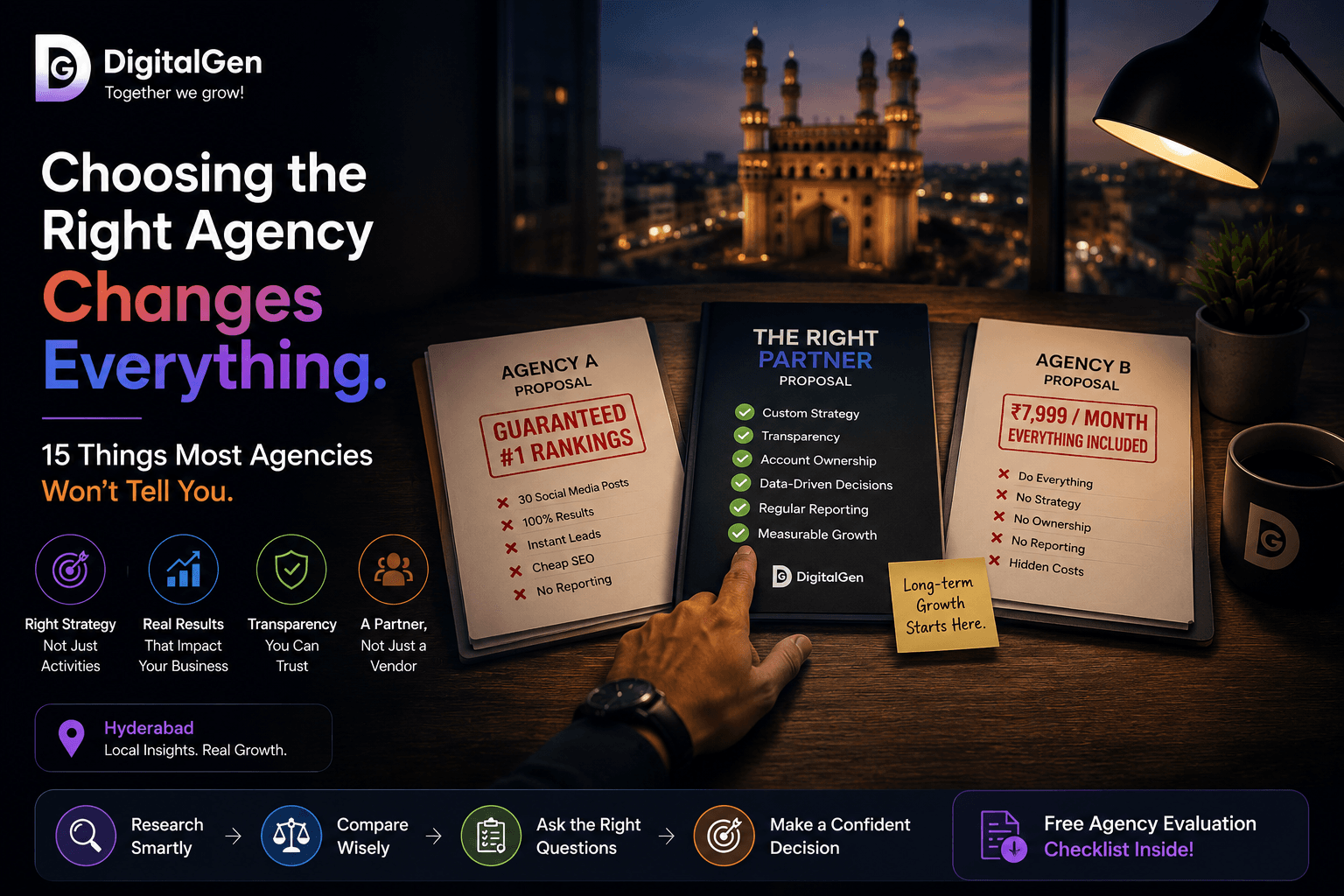
One simple way to see the pattern across all 15: a cheap, cookie-cutter proposal and a genuinely strategic one often look deceptively similar on the surface.
1. Rankings Can't Be Guaranteed
Google’s own official documentation states plainly: “No one can guarantee a #1 ranking on Google. Beware of SEOs that claim to guarantee rankings, allege a ‘special relationship’ with Google, or advertise a ‘priority submit’ to Google.” This is from Google Search Central’s official “Do you need an SEO?” guidance, not one agency’s opinion. Any agency promising a specific ranking position is either misunderstanding how search works or hoping you won’t check.
2. Cheap Packages Usually Mean Cookie-Cutter Strategies
A retainer priced far below the market range typically means templated content, no real strategy call, and minimal ongoing optimisation, since genuine strategy work takes real time that has to be paid for somehow. We've reviewed proposals from other agencies where the exact same 12-point package appeared word for word for a jewellery store, a gym, and a law firm, only the client's name had changed.
3. Followers Don't Equal Customers
A page can gain thousands of followers with zero enquiries if the audience isn't the right one. A useful test during evaluation: ask an agency to describe, in one sentence, the actual path from a follower seeing a post to that follower becoming a paying customer. If they can't answer specifically, the follower count they're chasing likely isn't tied to a real strategy.
4. You Should Own Your Website, Domain, Analytics, and Ad Accounts
Your domain registration, Google Analytics 4 property, Google Ads account, and website hosting should all be under your business's own ownership, not the agency's. If you ever switch providers, you should be able to leave with everything intact, not start from zero.
5. SEO Takes Time
Because Google's ranking systems weigh site quality, relevance, and trust signals that build up over time, meaningful SEO movement realistically takes months, not days. Any promise of page-one rankings within days or weeks should be treated as a red flag rather than good news.
6. Google Ads Isn’t "Set and Forget"
Ongoing keyword refinement, budget reallocation, and creative testing are part of running Google Ads properly, not optional extras. If an agency's monthly involvement in your ad account is limited to checking whether the campaign is still technically running, you're paying for setup, not management.
7. A Beautiful Website Doesn't Automatically Generate Leads
Design and conversion are different disciplines. A visually stunning site with a confusing user journey, no clear calls to action, or poor technical SEO can still fail to generate enquiries. Both matter, and neither replaces the other.
8. Reporting Should Focus on Business Results
Qualified leads, revenue, phone calls, website enquiries, and appointments booked are business results. Likes, followers, and impressions are activity metrics. A good report leads with the former and uses the latter only as supporting context.
9. Not Every Business Needs Every Marketing Channel
A B2B manufacturing company likely needs almost none of the Instagram-heavy strategy that a restaurant depends on, and a clinic's priorities look very different from an e-commerce brand's. One mistake we repeatedly notice: businesses ask us for a full social media package purely because a competitor has one, without first asking whether their own buyers are actually spending time on that platform.
10. Great Content Beats More Content
A handful of genuinely useful, specific pieces tends to outperform a high volume of generic posts, both for search visibility and for actual reader trust. Publishing frequency matters less than most agencies imply when volume is the entire pitch.
11. Reviews Matter More Than Fancy Brochures
According to BrightLocal’s 2026 Local Consumer Review Survey, 97% of consumers read reviews before choosing a local business. A polished brochure or pitch deck carries far less weight with an actual buyer than a genuine set of recent reviews.
12. Local SEO Is Often Ignored
A complete Google Business Profile directly affects whether a business appears in Google Maps and local search results, yet it’s frequently left half-finished while budget goes entirely toward paid ads.
13. Long-Term Strategy Beats Quick Hacks
Tactics that produce a short-term spike, such as aggressive link schemes, engagement pods, or purchased followers, frequently cause a longer-term penalty or collapse once a platform or Google adjusts its detection. A strategy built to hold up over a year looks less exciting month one, and considerably better by month twelve.
14. Communication Is as Important as Marketing
Regular review meetings, monthly reporting, and ongoing strategy discussion are what let you actually understand what's happening with your own marketing. An agency that goes quiet between invoices is asking for blind trust, not offering a partnership.
15. A Good Agency Should Educate You
You should finish every conversation with an agency understanding more about your own marketing than you did before, not less. An agency that hides its process, avoids specifics, or discourages questions is optimising for your dependence, not your growth.
6. Questions to Ask Before Hiring
7. Red Flags
8. Green Flags
9. Agency Evaluation Scorecard
A simple way to compare multiple proposals side by side: score each agency 0 to 2 on every row (0 = absent, 1 = partial, 2 = clearly present) and total them.
A proposal scoring consistently low across several rows is worth a second, harder look, regardless of how confident the pitch sounded.
10. What Digital Marketing Costs in Hyderabad
These are general market ranges observed across the Hyderabad agency landscape, not DigitalGen’s own rate card, since actual pricing depends heavily on scope, industry, and competition.
What actually drives price: the competitiveness of your industry and keywords, the number of channels involved, whether content and design are included, and the seniority of the team actually working on your account.
11. What Results Should You Actually Expect
These ranges reflect general industry experience, not a fixed guarantee, since Google itself does not publish a fixed SEO timeline, and results vary meaningfully by industry, competition, and budget. Anyone promising identical timelines regardless of your starting point and market is glossing over a variable that genuinely matters.
It’s also worth distinguishing between paid and organic timelines specifically. Google Ads can generate clicks and enquiries within days of launch, since you’re paying for placement rather than earning it, while SEO’s slower timeline reflects the fact that trust and relevance have to be demonstrated to Google over time, not purchased outright. A balanced strategy typically uses paid channels for near-term results while SEO compounds in the background.
12. Priorities by Industry (Hyderabad Context)
13. How DigitalGen Actually Works
This isn’t a claim that our process is the only correct one, it’s simply an honest answer to a question this whole guide has been asking you to put to every agency: what does your actual process look like, step by step? A discovery call establishes your business goals and constraints. An audit reviews your current website, SEO, and existing marketing assets. Competitor analysis shows where you stand against others in your specific market and locality. Strategy translates that research into a documented plan specific to your business, not a template. Execution and monthly review keep that plan honest against real data, and ongoing optimisation is what separates a campaign that improves over a year from one that quietly decays.
14. Practical Examples: Real DigitalGen Work
Section 6 above suggests asking any agency to see real, verifiable client work rather than taking claims at face value. Here’s what that actually looks like for DigitalGen, across both web development and social media marketing, with real, checkable results wherever they exist.
Worth a closer look specifically at CD India(cdindia.in), a Bangalore-based construction, interior design, architecture, and renovation company, since it’s a useful, publicly viewable example of one part of digital marketing, the website itself, done properly, independent of any performance data. Worth noting:
A strong website, or a strong social media page, is one component of digital marketing, not the whole of it, which is exactly the point of this guide: no single service, however well executed, replaces a complete strategy. That’s also why these four examples span two different services rather than just one, real proof should hold up across whatever you’re actually hiring an agency for.
15. Why Transparency Matters More Than Promises
An honest agency talks in ranges and processes, not guarantees. It discusses realistic expectations upfront, communicates regularly rather than only at renewal time, keeps optimising rather than treating a campaign as finished at launch, bases decisions on data rather than opinion, and aims to build a long-term partnership rather than a one-off project. Every point in this guide traces back to that single idea.
The uncomfortable truth is that transparency is genuinely harder to sell than a bold promise. “We’ll get you page one in 30 days” is a more exciting sentence than “we’ll show you exactly what we’re doing and why, and here’s a realistic range of when you might see movement.” But only one of those two sentences survives contact with how search engines and ad platforms actually work. When you’re comparing proposals, weigh confidence in the process more heavily than confidence in the outcome, since the process is the only part any agency actually controls.
16. How to Compare Two Agency Proposals
Say you’re holding two real proposals. Proposal A is ₹20,000 a month for SEO, Google Ads, and social media. Proposal B is ₹45,000 a month for what looks like the same three services. Most people default to comparing the price alone, which is exactly the wrong place to start.
A ₹20,000 proposal that’s honest about a lighter scope, fewer channels, less reporting depth, can be the more trustworthy option than a ₹45,000 proposal padded with vague promises. The price difference should map to a real difference in deliverables and depth, not just confidence in the pitch. If a cheaper and a pricier proposal read almost identically once you strip out the number, that’s worth asking about directly before signing either one.
17. Agency Evaluation & Discovery Call Checklists
Agency Evaluation Checklist
Discovery Call Checklist
Need Digital Marketing Services in Hyderabad?
For SEO, social media marketing, web development, online reputation management, or Google Ads.
18. Frequently Asked Questions
Related Guides From DigitalGen
Found this useful? Share it with someone who needs it.