How Website Speed Quietly Kills Your Sales
☰ Table of Contents
Picture a customer in Hyderabad searching on their phone for a service you offer. They tap your link. The page hangs for a moment. A blank screen, then a slow crawl of half loaded images. Two seconds pass, then three. Before your website has finished loading, they have already hit the back button and tapped your competitor instead. You never got a complaint, never got an email, never even knew they were there. That is how website speed quietly kills your sales, every single day.
Most business owners never see the customers they lose to a slow website. If your site takes a few seconds too long to load, you are almost certainly losing enquiries you never knew existed. In this guide, DigitalGen, a performance driven digital marketing agency in Hyderabad, explains how page speed affects your revenue, what Google's Core Web Vitals actually measure, and how to fix a slow website before it costs you any more business.
What Are Core Web Vitals?
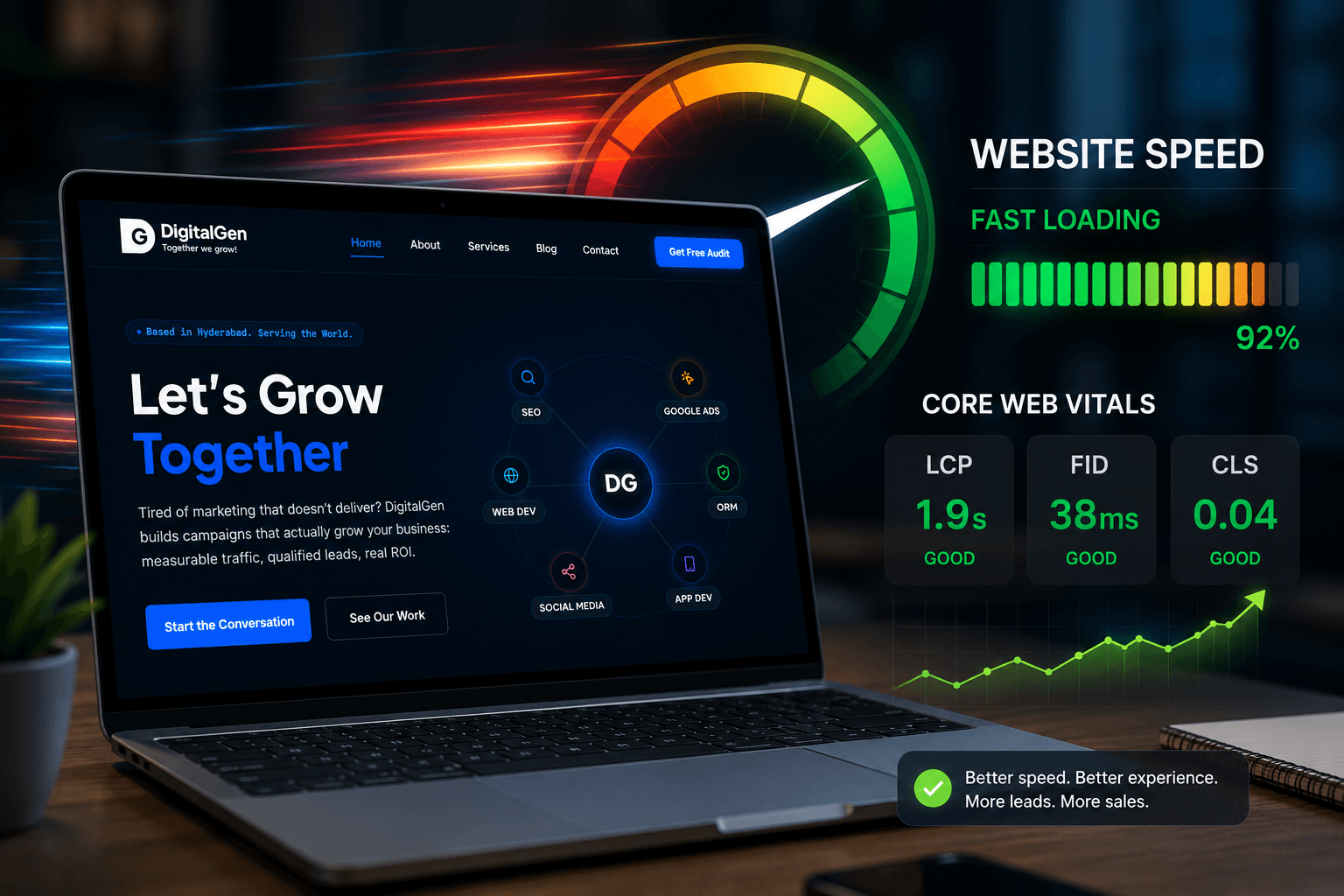
Because website speed matters so much, Google built a way to measure it that reflects how real people experience a page. These measurements are called Core Web Vitals, and there are three of them. You do not need to be a developer to understand what they mean.
Largest Contentful Paint (LCP): loading speed
LCP marks the moment the largest visible thing on your screen, usually a main image or a big block of text, has finished loading. It answers one question: how long before the visitor sees your main content? Google considers anything under 2.5 seconds to be good, between 2.5 and 4 seconds needs improvement, and over 4 seconds poor.
Interaction to Next Paint (INP): responsiveness
INP measures how quickly your page reacts when a visitor taps a button, opens a menu, or fills in a form. A good INP score is under 200 milliseconds, and anything over 500 milliseconds is poor. This metric replaced an older one called First Input Delay in March 2024, and it is now the metric most websites fail. Around 43 percent of sites do not pass it, because fixing it means rethinking how a site handles interactions rather than simply shrinking an image.
Cumulative Layout Shift (CLS): visual stability
CLS measures how much your page jumps around as it loads. Have you ever gone to tap a button, only for the page to shift at the last second so you tap the wrong thing? That is layout shift. A good CLS score is under 0.1. It usually happens when images, ads, or fonts load without space reserved for them.
Here is the detail that catches most people out. Google does not judge these scores on your fast office laptop with fibre internet. It measures the experience of your real visitors, and a page only passes when at least 75 percent of visits hit the good threshold. In practice, your site has to be fast for someone on a mid range Android phone on a patchy mobile connection, not just fast for you. This is why mobile page speed matters so much, a point we also cover in our guide to building a website that converts.
Why Google Cares About Website Speed
Core Web Vitals have been an official Google ranking signal since 2021, and their weight in the algorithm has only grown, as we explained in our breakdown of the May 2026 Google core update. That means a slow website does not only lose the visitors who arrive. It also struggles to get found in the first place, because Google is less likely to rank it well against faster competitors.
This matters even more on mobile. The majority of searches now happen on phones, and Google uses your mobile performance as the primary signal for ranking, even for people searching on a desktop. The result is a double loss: a slow site ranks lower, so fewer people find it through SEO, and the visitors who do find it are more likely to leave before they buy or enquire. Website speed sits quietly underneath both your search rankings and your sales.
Speed Is a Business Problem, Not Just a Technical One
It is tempting to file website speed under things for the tech person to worry about. That is a costly mistake, and the data proves it.
A landmark study by Deloitte, published by Google under the title Milliseconds Make Millions, looked at what happened when sites improved their speed by just one tenth of a second. Retail businesses saw customers spend 9.2 percent more on average. Travel sites saw conversions climb by 10.1 percent. These were not huge rebuilds. They came from a single 0.1 second improvement in page speed.
Most relevant of all for service and B2B businesses is this finding: progression to the "Contact Us" page rose by 20.6 percent from that same tiny speed improvement. If your website's job is to turn visitors into enquiries and leads, website speed is directly tied to how many of those enquiries you actually receive.
What Actually Makes a Website Slow
Slow websites usually share a small set of causes. The good news is that almost every one of them is fixable. A slow website is rarely a lost cause, it is usually a site that was built without performance in mind.
A specialist web development team will optimise every image, minify your code, set up caching, choose fast hosting, and test regularly using Google PageSpeed Insights, aiming for a score above 90 and green Core Web Vitals across mobile and desktop.
How DigitalGen Builds for Website Speed
At DigitalGen, we treat website speed as a core part of building a website, not an afterthought bolted on at the end. A website that looks beautiful but loads slowly is failing at its real job, which is to win customers and enquiries.
When we recently built the website for Milling Equips, an engineering company specialising in feed milling, grain storage, and rice processing, our goal was never just a good looking page. It was a fast, clear, credible website that could work as a genuine business tool and earn the trust of serious industrial buyers. The client's own words captured what we aim for on every project:
"We recently partnered with DigitalGen to build our website, and the experience was exceptional. The team didn't just design a website; they took the time to deeply understand our business goals and target audience. The final product is seamless, modern, and built with a strong strategic foundation."
You can see the result at millingequips.com. As your long term web development partner, we do not just hand over a website and walk away. We build it fast from day one, then monitor and optimise your website speed, because your growth depends on it.
Is your slow website costing you customers?
If your site takes more than a few seconds to load, the numbers in this guide suggest you are losing real business every day. Our free website audit checks your page speed, your Core Web Vitals, and the technical issues holding back your sales, explained in clear language with no jargon and no obligation. Let us show you exactly how much speed could be adding to your bottom line.
Frequently Asked Questions
Related Guides From DigitalGen
Found this useful? Share it with someone who needs it.