Online Reputation Management vs Social Media Management: What Does Your Business Actually Need?
☰ Table of Contents
- 1. Introduction: A Customer Complaint Is Not Limited to One Platform
- 2. What Is Social Media Management?
- 3. What Is Online Reputation Management (ORM)?
- 4. ORM vs Social Media Management: The Key Differences
- 5. Where the Two Services Overlap
- 6. Which Service Does Your Business Need?
- 7. A Practical Way to Manage Both Together
- 8. How DigitalGen Approaches Social Media and ORM
- 9. Conclusion
- 10. Frequently Asked Questions
1. Introduction: A Customer Complaint Is Not Limited to One Platform
Imagine a customer visits a restaurant in Hyderabad and has a disappointing experience. They may leave a review on Google, post a comment on the restaurant’s Instagram page, share the experience in a local Facebook group, or mention the brand in a public post. Other potential customers may see those conversations before deciding whether to visit.
The business now has more than a content problem. It has a customer communication and reputation issue. Responding to the Instagram comment is important, but it may not address the Google review or the wider conversation elsewhere online.
This is where business owners sometimes confuse social media management with Online Reputation Management. Both involve how a brand communicates with people online. However, they do not cover exactly the same work.
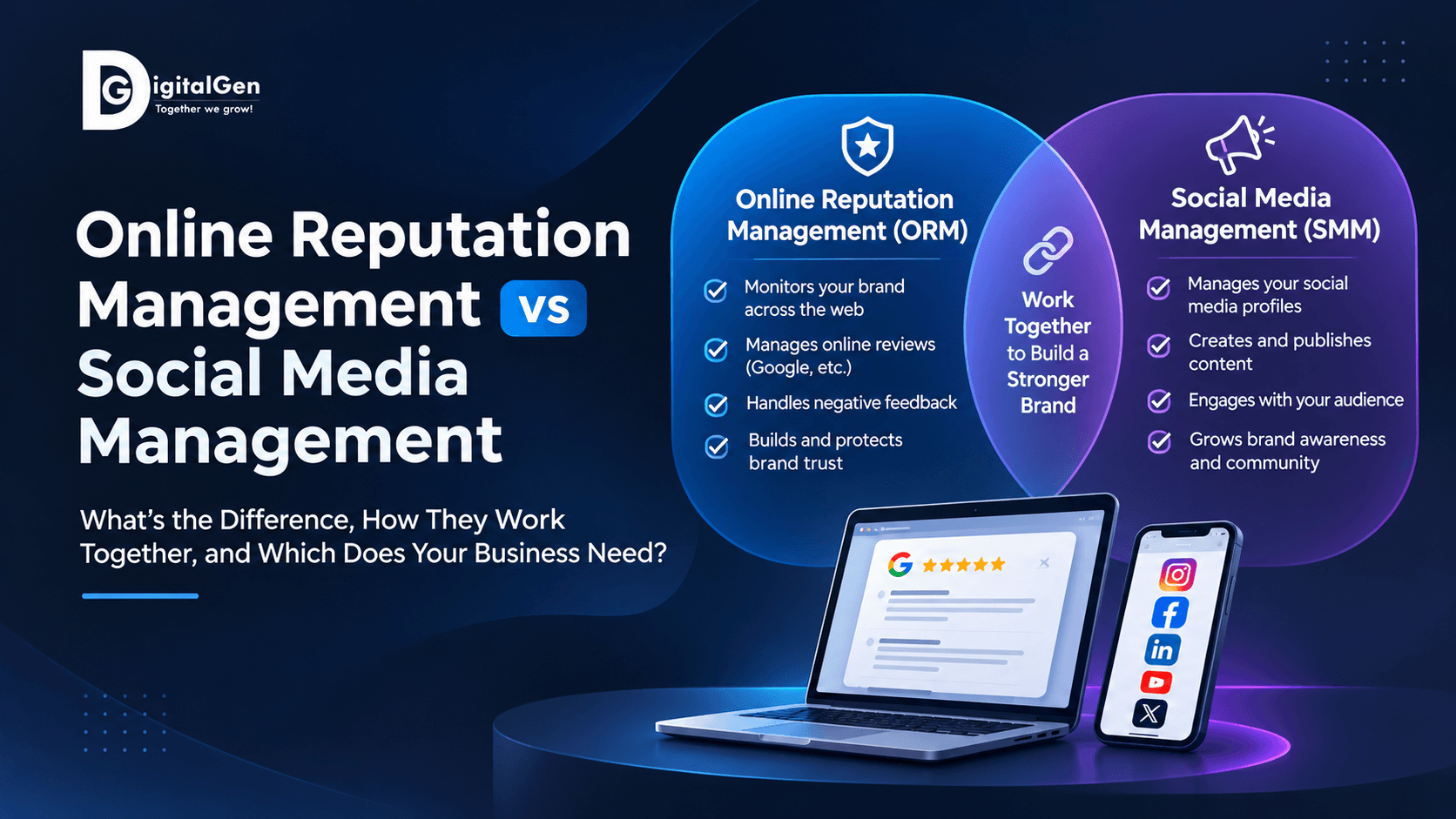
The simplest way to understand the difference: social media management helps a business manage its presence and relationships on social platforms; ORM helps a business monitor, understand and respond to its reputation across the wider online environment.
2. What Is Social Media Management?
Social media management is the ongoing planning, creation, publishing and management of a business’s presence on platforms such as Instagram, Facebook, LinkedIn and YouTube. Depending on the scope of work, it can also include community engagement, paid social campaigns and reporting.
The objective is not simply to post regularly. A well-planned social media programme connects content with a business goal, whether that is improving brand awareness, building a community, explaining products or services, generating enquiries or supporting customer relationships.
What does social media management typically include?
These activities align with the scope described on DigitalGen’s Social Media Marketing service page, which covers content calendars, creative production, captions, community management, paid social and performance reporting.
For example, a school may use Instagram to share classroom activities, parent testimonials, event updates and admission information. The purpose is to keep parents informed, demonstrate the school experience and encourage relevant enquiries. That is social media management.
3. What Is Online Reputation Management (ORM)?
Online Reputation Management is the process of monitoring and managing how a business, brand, product or individual is perceived across online sources. These sources can include customer review platforms, business listings, social networks, discussion forums, news websites, app stores and search engine results.
ORM is broader than replying to negative comments. It involves understanding what people are saying, identifying issues that may affect trust, responding appropriately, encouraging genuine customer feedback and improving the accuracy and quality of the information people encounter when researching a brand. For a deeper introduction, read our guide on how a single bad Google review can quietly cost you customers.
What does ORM typically include?
DigitalGen’s Online Reputation Management service describes work such as review management, brand monitoring, negative-content response and ongoing reputation reporting.
Consider a healthcare clinic receiving a one-star Google review about appointment delays. A suitable ORM process would verify the issue internally, prepare a professional public response without disclosing patient information, and route the operational complaint to the clinic team. If similar feedback appears repeatedly, the business should investigate the underlying service issue rather than treating every review as an isolated public-relations task.
4. ORM vs Social Media Management: The Key Differences
The easiest way to distinguish the two is to compare their primary focus, platforms, activities and measures of success. The exact scope can vary by agency and package, so businesses should always confirm what is included in a service agreement.
Key takeaway: social media management is primarily channel-focused. ORM is reputation-focused and can span several channels. Social media can be one of the places where reputation is built, challenged and managed.
5. Where the Two Services Overlap
The distinction becomes less obvious when a customer raises a complaint on a social platform. For example, a customer comments on a brand’s Facebook post saying that an order arrived late.
The social media team may acknowledge the comment, ask the customer to share the order details privately and route the matter to customer support. That is community management. If the complaint is part of a wider pattern, attracts public attention or affects how other customers view the brand, it also becomes an ORM concern.
A simple example
This is why the two functions should share clear response guidelines. The social media team needs to know which issues it can resolve directly and which must be escalated to customer support, operations, management or the ORM team.
6. Which Service Does Your Business Need?
The right choice depends on the problem you are trying to solve. A business that has no consistent social presence may need social media management first. A business receiving reviews across multiple platforms, facing public complaints or seeing damaging information in branded search results may need a more structured ORM programme.
Social media management may be the immediate priority if:
ORM may be the immediate priority if:
When should you consider both?
If your business depends on customer trust and receives attention across multiple channels, managing social media and ORM together is often more practical. This is particularly relevant for clinics, schools, restaurants, hospitality businesses, real estate companies, professional services and consumer brands.
For example, a preschool may use social media to show learning activities and communicate with parents, while ORM helps the management team monitor public reviews and respond to feedback about parent experience. These activities support the same trust-building goal, but they require different workflows.
7. A Practical Way to Manage Both Together
A business does not need two disconnected teams replying to the same customer. It needs a shared process that makes ownership clear.
A few important safeguards
Google explains its review requirements in its official Tips to get more reviews guidance and its prohibited and restricted content policy. Businesses can report reviews they believe violate policy, but reporting does not guarantee removal. See also Google’s instructions for managing customer reviews.
8. How DigitalGen Approaches Social Media and ORM
At DigitalGen, social media management and ORM are separate service areas because they solve different business problems. They can also complement one another when a business needs a consistent approach to visibility, customer communication and trust.
Our Social Media Marketing service focuses on platform-specific content strategy, creative production, publishing, community management and performance reporting. Our ORM service focuses on review management, brand monitoring, reputation issues and the wider online presence of a business.
Examples from DigitalGen’s work
The Footprints Pre-School case studyshows how organic Instagram content was used to build parent trust and support admissions. The published case study reports 101.8K views in the 30-day period shown in the client’s Instagram professional dashboard and 34 admissions attributed to the social media work. This is an example of social media marketing, not an ORM result.
The Nagpal’s Hyderabad case studydescribes how organic social media and the founder’s personal communication helped the restaurant explain its relocation and reconnect with its audience. It illustrates the role of social communication during a business change; it should not be interpreted as a review-management case study.
For a different trust touchpoint, the Milling Equips case studyexplains how a clearer, conversion-focused website helped communicate the company’s capabilities to industrial buyers. A website, social presence and online reviews all contribute to the information a potential customer uses when evaluating a business.
The right combination depends on your current online presence, customer journey, industry and business goals. We recommend starting with an audit rather than assuming every business needs the same package.
9. Conclusion: Visibility and Reputation Need Different Kinds of Attention
Social media management helps a business communicate consistently, publish useful content and build relationships with its audience. ORM helps the business understand and manage what people find and say about it across the wider internet. One supports an active brand presence; the other protects and strengthens trust wherever the brand is discussed.
They overlap, but one does not replace the other. A strong social media presence cannot compensate for ignored reviews, and review responses alone cannot create a meaningful content strategy. Businesses that need both should connect the teams through shared guidelines, clear escalation and honest reporting.
The starting point is simple: understand where your customers talk about you, what they need from your business and what information they see before making a decision.
Want to Understand Which Approach Makes Sense for Your Business?
Talk to DigitalGen about your current online presence and business goals. We’ll help you work out the right next step.
10. Frequently Asked Questions
Related Guides From DigitalGen
Found this useful? Share it with someone who needs it.