What Does an Online Reputation Management (ORM) Agency Actually Do?
☰ Table of Contents
- 1. What Is Online Reputation Management?
- 2. So What Does an ORM Agency Actually Do?
- 3. What ORM Does Not Mean
- 4. How Google Review Management Actually Works
- 5. Can an ORM Agency Remove Negative Google Reviews?
- 6. ORM in the Age of AI Search
- 7. How to Tell If Your Business Needs ORM
- 8. How to Choose an ORM Agency
- 9. How DigitalGen Helps Businesses Manage Their Online Reputation
- 10. Frequently Asked Questions
Most business owners meet ORM at the worst possible moment. A one-star review lands on the first page of Google. A former employee posts something unfair. A competitor’s complaint thread starts ranking for the brand name. The instinct is simple and understandable: make it go away. So the first question people ask an agency is usually, “Can you delete this?”
That is the wrong first question, and this article exists to replace it with a better one: what am I actually paying an ORM agency to do?
1. What Is Online Reputation Management?
Online reputation management (ORM) is the ongoing practice of shaping how a business, brand, professional or organisation is represented across the internet. It covers everything a potential customer might encounter before they contact you: your Google reviews and star rating, the search results for your name, your Google Business Profile, your social media presence, mentions on news sites and forums, and listings on third-party platforms.
People often use “ORM” and “review management” as if they mean the same thing. They don’t. Review management is one important part of ORM, but it is only part. A business can have a healthy star rating and still have a reputation problem if the first search result for its name is a two-year-old complaint or an outdated address.
If you want the broad, ground-level overview of the discipline, our earlier guide on how a single bad Google review can quietly cost you customersis a good starting point. This article goes in a different direction: less “what is ORM” and more “what does an ORM agency actually deliver, and how do you judge whether it’s worth paying for.”
2. So What Does an ORM Agency Actually Do?
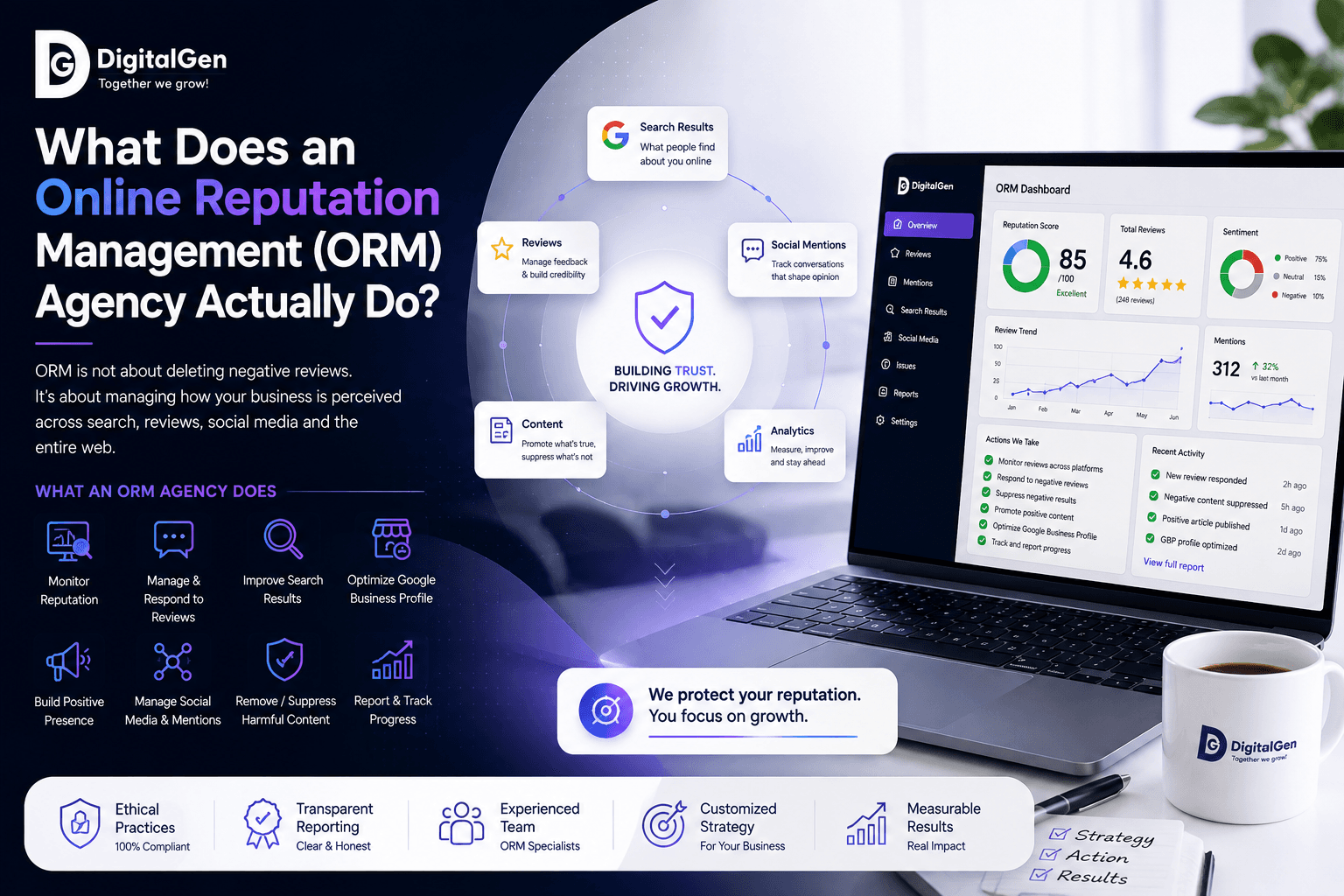
A good online reputation management agency is not a firefighting service you call once. It’s a system for watching, protecting and strengthening how your business shows up online, continuously. Here is what that work actually looks like in practice, starting with the online reputation management agency service itself.
1. It Monitors What People Find When They Search Your Business
Before anything is fixed, it has to be found. The first job is a full audit: what appears when someone searches your brand name, what your reviews say across platforms, where negative content sits, and whether the basic facts about your business are correct and consistent everywhere. From there, ORM shifts into continuous monitoring, tracking new reviews, mentions and search movements so that problems are caught while they're small, not after they've spread.
2. It Manages Google Reviews and Customer Feedback
Reviews are usually the loudest signal in local search, so a large part of ORM is disciplined review management: keeping track of new reviews as they arrive, making sure genuine ones get thoughtful replies, and building an ethical, steady flow of honest feedback from real customers. The goal is more real reviews, never manufactured ones.
3. It Responds to Negative Reviews Strategically
A negative review is not automatically a disaster. Often it's an opportunity to show future customers how you handle problems. An ORM agency helps you respond calmly and factually, acknowledge the issue, and move the actual resolution into a private channel where it belongs.
4. It Manages Your Google Business Profile
For most local businesses, the Google Business Profile is the storefront customers see before the website. Managing it well is core reputation work. If your profile isn’t set up properly yet, our step-by-step guide to setting up and optimising a Google Business Profile in India walks through the essentials, and our piece on why local businesses need both a profile and a website explains how the two work together.
5. It Watches Search Results and Brand Mentions
Reputation isn't only reviews. It's the entire first page for your name. An ORM agency tracks where your brand is mentioned, news, blogs, directories, social posts, and watches the ranking of both positive and negative results. When something damaging starts climbing, the response is not to hide it but to publish and strengthen accurate, authoritative content.
6. It Manages Social Media Reputation
Comments, tags, messages and mentions on Instagram, Facebook and LinkedIn all shape perception, and they move fast. Coordinating reputation with your social media marketing means questions get answered, criticism is handled with care, and a consistent brand voice shows up everywhere a customer might be paying attention.
7. It Corrects Inaccurate or Misleading Information
Sometimes the problem isn't an opinion, it's a fact that's simply wrong: an old phone number, a closed branch still listed as open, a duplicate profile, a mismatched address. A meaningful share of ORM is unglamorous cleanup: finding wrong information across the web and getting it corrected at the source.
8. It Builds Positive, Authoritative Brand Information
The most durable way to improve a reputation is to give people more accurate, genuinely useful information about your business. That overlaps heavily with content and branding and with SEO: well-optimised service pages, helpful articles, real case studies and consistent brand profiles that rank for your name.
9. It Monitors Third-Party Platforms and Communities
Depending on your industry, reputation may be decided on platforms you rarely check. Employers are judged on AmbitionBox, Glassdoor and Indeed; apps on the Play Store and App Store; restaurants and local services on their maps listings. Our deep dive on managing your employer reputation across AmbitionBox, Glassdoor and Indeed shows how much can hinge on platforms outside your website.
10. It Tracks Changes and Reports Honestly
Finally, reputation work has to be measurable. That means clear baselines and honest monthly reporting: star-rating changes, review volume, how many reviews received a response, sentiment trends, and movement in branded search results. Transparent reporting is also how you separate a real agency from one that is simply sending reassuring emails.
3. What ORM Does Not Mean
This is the section most agencies skip, and it’s the one that protects you most. Ethical ORM does not include:
These aren’t just etiquette rules, they’re written policy. Google’s prohibited and restricted content guidelines explicitly disallow fake engagement, content posted because of an incentive, and reviews based on a conflict of interest such as those from current or former employees, competitors or family. Businesses that violate the fake-engagement policy can have reviews removed and face restrictions on their Business Profile.
In the United States, this went beyond platform policy in 2024: the Federal Trade Commission’s final rule on fake reviews and testimonials prohibits buying or selling fake reviews. India is moving in the same direction with IS 19000:2022 for online consumer reviews. The practical takeaway is blunt: any agency that offers to manufacture a rating is offering to put your business at risk. Buying reputation is not managing it.
4. How Google Review Management Actually Works
Because reviews sit at the centre of so much ORM, it’s worth being precise about how the mechanics work, from Google’s own documentation, not from folklore.
5. Can an ORM Agency Remove Negative Google Reviews?
Here’s the honest, direct answer, because it’s the single most misunderstood point in this whole topic.
An ORM agency cannot delete a genuine negative review simply because it is negative.
What a professional agency can do is identify reviews that appear to violate Google’s policies, fake reviews from non-customers, competitor or employee reviews, spam, off-topic content, or content with prohibited material, and report them for removalwith clear evidence. Whether Google removes them is Google’s decision, not the agency’s, and removal is never guaranteed. If an agency promises to “remove any negative review,” treat that as a warning sign, not a selling point.
6. ORM in the Age of AI Search
Search is changing, and reputation is changing with it. Google now shows AI-generated summaries, AI Overviews, and an AI Mode that answers more complex questions by pulling together information from many sources at once. For a plain-language look at how this shifts customer behaviour, our article on how AI is changing the way people search is a useful primer.
There is a lot of hype about “GEO,” “AEO” and gaming AI answers. Google’s own guidance is refreshingly plain about it. In its documentation on AI features and your website, Google states there are no additional requirements and no special optimisations needed to appear in AI Overviews or AI Mode, the normal fundamentals of good, people-first content still apply.
So no responsible agency can guarantee that your brand will be recommended by an AI assistant. What it can do is make sure the information an AI is likely to synthesise about your business is accurate, consistent and authoritative across the web. If your name, services, location and key facts contradict each other across your website, your profile and third-party listings, you make it harder for any system, human or AI, to represent you correctly.
7. How to Tell If Your Business Needs ORM
You probably don’t need a formal audit to sense a problem, but here are the practical signals. Consider ORM seriously if several of these are true:
One uncomfortable answer is worth watching. Several is worth a conversation.
8. How to Choose an ORM Agency
This is where your money is either well spent or quietly wasted, so evaluate carefully. A credible reputation management company should start with an audit and show you a clear map of where you stand before proposing work. It should explain its review-management and monitoring process, be honest about what it can and cannot remove, and commit to transparent, regular reporting against baselines you agree on up front.
Be very cautious of anyone promising:
Every one of those promises requires either a policy violation or a claim no one can actually control. If you want a broader framework for vetting any marketing partner, our guide on choosing a digital marketing company in Hyderabadcovers the questions most agencies would rather you didn’t ask.
9. How DigitalGen Helps Businesses Manage Their Online Reputation
With that foundation in place, here’s how DigitalGen approaches reputation, matched to the problems businesses actually walk in with.
We start with a reputation audit across your branded search results, review platforms and social mentions, so you get a clear picture before any work begins. That’s the whole point of our ORM service and our free audit.
We help you monitor reviews and reply professionally, and build an ethical, steady flow of genuine feedback, never fake reviews or anything that breaks Google’s policies.
We tie reputation to local visibility and web development, making sure your profile, website and listings tell one accurate, trustworthy story. Our work with Milling Equips, a website built specifically to earn industrial buyers’ trust, is a good example of credibility engineered on purpose.
We use accurate, authoritative content and SEO to strengthen the true picture of your business, rather than any manipulative suppression trick.
We align reputation with social media marketing. The growth stories behind Footprints Pre-School and Nagpal’s show how a consistent, genuine social presence rebuilds trust and attention.
Because DigitalGen is a full-service digital marketing agency in Hyderabad, reputation doesn’t sit in a silo, it works alongside SEO, content, local search, Google Ads and web development, which is how sustainable reputation improvement actually happens.
Not Sure What Customers See When They Search Your Business?
That’s the real starting point, not a delete button. We’ll audit your reviews, branded search results and Google presence, then show you clearly which areas deserve attention first.
10. Frequently Asked Questions
Related Guides From DigitalGen
Found this useful? Share it with someone who needs it.