AI Is Changing Property Searches. Is Your Real Estate Business Ready?
☰ Table of Contents
- 1. The Home-Buying Journey Has Changed
- 2. AI Search and SEO: The New Front Door
- 3. Your Website Still Has to Do the Work
- 4. Google Reviews and Reputation
- 5. Google Business Profile: Winning the Map
- 6. Content Marketing: Answering Before They Ask
- 7. Social Media: Where Buyers Verify You’re Real
- 8. Google Ads: AI Doesn’t Replace Paid Visibility
- 9. The Trends Behind This Shift
- Frequently Asked Questions
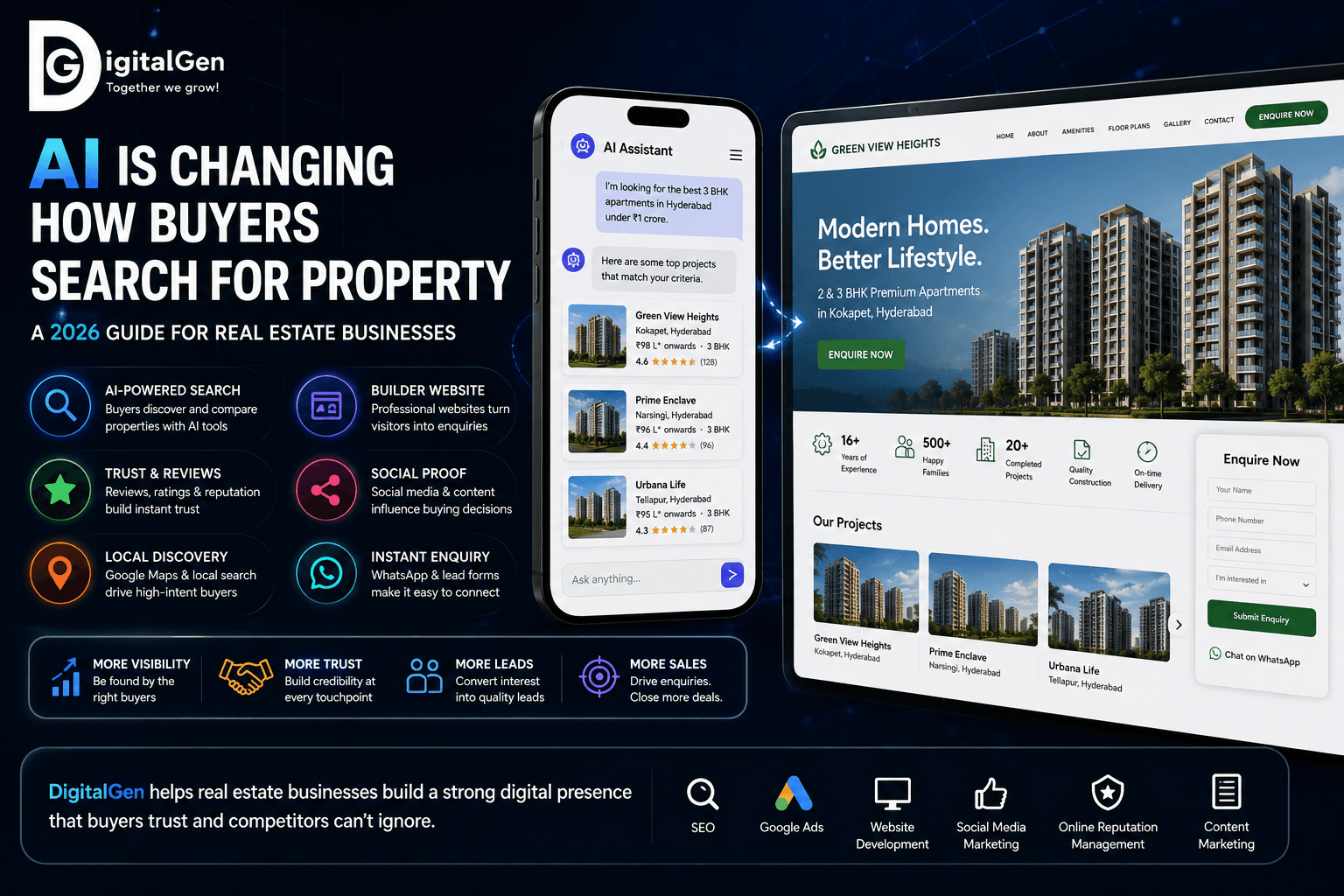
A buyer researching a 2 BHK in your city increasingly doesn’t start on a property portal anymore. They start with a question, typed into ChatGPT or Google’s AI Overview, asking which localities are worth considering, what a fair price looks like, or whether a builder is trustworthy. By the time they land on your website, they’ve often already formed an opinion about your business, without you ever knowing they were looking.
This shift is real, but it is not a reason to panic or to chase every new AI tool. Google’s own Search Central team has been explicit: SEO best practices continue to be relevant, because generative AI features on Google Search are rooted in the same core ranking and quality systems that have always existed. This guide, from DigitalGen, explains what that means in practice for a real estate builder, developer, or agency. If you have been searching for digital marketing for real estate that actually reflects how buyers behave in 2026, this is that starting point.
1. The Home-Buying Journey Has Changed
The old journey was simple: a buyer browsed a property portal, then called the builder. The journey now looks more like a chain, with several stages a business needs to show up in, not just one.
Each link in that chain is a place a buyer can either find your business and trust it, or quietly move on to a competitor who shows up more clearly. The rest of this guide walks through each stage and what actually needs to be in place there.
2. AI Search and SEO: The New Front Door
Google’s own documentation, “Optimizing your website for generative AI features on Google Search,” states plainly that there are no additional requirements to appear in AI Overviews or AI Mode, and no special optimisations necessary beyond the fundamentals. To be eligible to appear as a supporting link in an AI-generated answer, a page simply needs to be indexed and eligible to appear in regular Google Search.
In other words, AI search is not a separate game requiring a separate strategy. It is built on top of the same index. As Nikiya Griffith, Director of Organic Growth at BX Studio, put it, roughly 80 percent of the time, what’s good for SEO is good for what the industry is calling GEO, generative engine optimisation. This is where DigitalGen’s core SEO work fits directly: technical SEO, content optimisation, a well-structured site, internal linking, and building genuine topical authority. A builder who has neglected SEO for years cannot expect to suddenly appear in AI-generated answers without first fixing the same foundation that was always required for regular search.
3. Your Website Still Has to Do the Work
An AI answer might introduce a buyer to your name, but it is your website that has to convert their interest into an enquiry. A good website for real estate businesses means the basics still decide whether this works: fast loading speed, mobile-first design, dedicated landing pages for each project, clear calls to action, and proper schema markup so both Google and AI systems can understand exactly what your page is about. We covered why loading speed alone can silently cost a business sales in our guide on how website speed affects your sales, and the same principle applies here. A slow project page loses the buyer that AI search just sent you.
A single generic “About Us” page trying to represent every project a builder has ever built does neither the buyer nor the search system any favours. Dedicated, well-structured landing pages per project, with clear pricing context, RERA details, and location information, give both AI systems and human visitors something specific and extractable to work with.
4. Google Reviews and Reputation: Trust Before the Enquiry
By the time a buyer reaches your website, they’ve likely already checked your reviews, whether through a direct Google search or because an AI summary referenced your rating. Trust signals like consistent, recent, genuine reviews matter to a human buyer for the same reason they matter to an AI system evaluating your business’s credibility: both are trying to answer the same question, can this business be trusted with a high-value decision. We covered exactly why this matters, with real figures, in our guide on how online reviews influence buying decisions.
This is where online reputation management earns its place in a real estate marketing plan, not as an afterthought, but as one of the trust signals sitting directly in the path between an AI-generated answer and an actual site visit.
5. Google Business Profile: Winning the Map
For a real estate business with a physical office, a sales gallery, or an active project site, Google Business Profile visibility feeds directly into both Google Maps and the local trust signals that AI systems draw on. Consistent name, address, and phone details across your profile and your website, the same NAP consistency principle we detailed in our guide on Google Business Profile and website, remain just as important in an AI-influenced search landscape as they were before it.
6. Content Marketing: Answering Before They Ask
Both AI Overviews and human buyers are drawn to content that answers a specific question clearly. For a real estate business, that means publishing genuinely useful material: locality guides, home-buying checklists, plain-language explanations of RERA and stamp duty, and honest project comparisons, not just listings. This kind of content builds the topical authority that Google’s own guidance repeatedly points to as a factor in generative AI visibility, and it is exactly the kind of content DigitalGen builds into every blog we publish, including this one.
8. Google Ads: AI Search Doesn’t Replace Paid Visibility
AI search changes how buyers discover a business, but it does not replace the need for paid visibility. There is currently no equivalent of Google Ads placement inside AI chat tools themselves, which means dominating traditional and paid search, Search Ads, Performance Max, and retargeting to buyers who’ve already shown interest, remains one of the fastest ways to generate qualified enquiries in the meantime.
9. The Trends Behind This Shift
A few underlying shifts explain why this matters now, and why acting on the fundamentals matters more than chasing any single tactic.
None of this requires a real estate business to adopt new AI tools of its own. It requires the same disciplined marketing fundamentals, done properly and consistently.
The Fundamentals Just Got More Important
AI is changing where a buyer’s property search begins, but it has not changed what makes a real estate business worth choosing once they arrive: a fast, trustworthy website, genuine reviews, a complete Google Business Profile, useful content, and an active, authentic social presence. Builders and agencies who already invest properly in these fundamentals are the ones best positioned to be found, cited, and trusted, however a buyer’s search happens to begin.
Not Sure Where Your Real Estate Business Stands?
DigitalGen is a real estate digital marketing agency helping builders, developers, and property consultants build the SEO, website, reputation, and content foundation that keeps them visible, whether a buyer starts on Google, on AI, or on Instagram.
Frequently Asked Questions
Related Guides From DigitalGen
Found this useful? Share it with someone who needs it.
7. Social Media: Where Buyers Verify You’re Real
Once a buyer has a shortlist, they often turn to Instagram and YouTube to verify a builder is real and active, construction updates, walkthrough videos, and genuine client testimonials all do work here that a static website page cannot. Done well, social media for real estate is not about posting listings, it is about proving a project is actually being built by actual people. This is precisely the kind of organic, trust-building content strategy we used for a very different client in our Footprints Pre-School case study, and the same logic applies directly to real estate: buyers want proof of activity and authenticity, not polished stock photography.