Digital Marketing for Real Estate: A Complete 2026 Guide for Builders and Agencies
☰ Table of Contents
- 1. Why Digital Marketing for Real Estate Looks Different Today
- 2. Your Website: The Foundation of Every Digital Presence
- 3. SEO for Builders: Local, Technical, and Content-Driven
- 4. Google Business Profile and Google Maps SEO
- 5. Google Reviews and Online Reputation Management
- 6. Social Media and Content Marketing for Builders
- 7. Google Ads and Lead Generation for Real Estate
- 8. Real Example: How a Strong Digital Presence Builds Trust
- 9. Choosing the Right Digital Marketing Company
- Frequently Asked Questions
A buyer’s decision to trust a builder is rarely made in a sales office anymore. It is made earlier, on a website, in a set of Google reviews, across an Instagram grid, long before an enquiry is ever submitted. Digital marketing for real estate is not one tactic among many, it is the sum of every one of those touchpoints, and buyers are quietly judging all of them at once.
1. Why Digital Marketing for Real Estate Looks Different Today
The National Association of Realtors’ 2025 Profile of Home Buyers and Sellers found that online search has remained the most common first step in the home-buying process for years running. This data comes from the US market, but the underlying pattern, buyers researching extensively online before contacting a builder or agent, reflects a global shift, not a regional quirk.
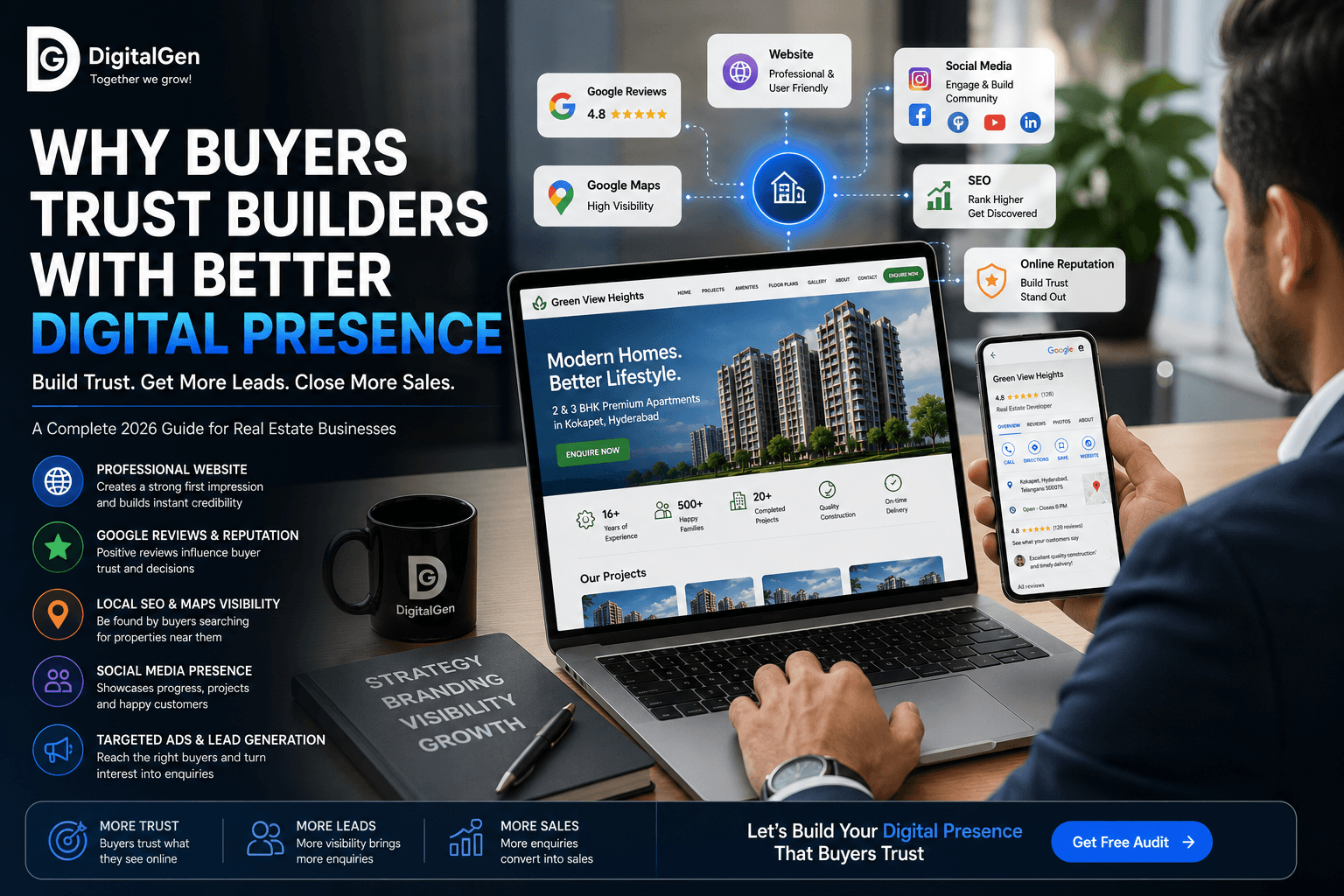
What this means practically is that digital marketing for real estate can no longer be treated as scattered tactics, a boosted Instagram post here, an occasional Google ad there. The builders and agencies who win are the ones who treat their website, SEO, Google Business Profile, reviews, and content as one connected system, because that is exactly how a buyer experiences them.
2. Your Website: The Foundation of Every Digital Presence
Every other channel, search, social, ads, eventually points back to one place: your website. Whether you call it a builder website, a property website, or simply your real estate website, the fundamentals of good website development for builders remain the same regardless of the label.
What a conversion-focused real estate website needs
DigitalGen approaches website development for builders with this in mind, treating the site as a working sales tool, not a digital brochure.
3. SEO for Builders: Local, Technical, and Content-Driven
Real estate SEO has three layers that need to work together. Technical SEO makes sure your site can actually be crawled and understood by Google Search, broken links, slow pages, and poor structure all quietly undermine everything else. Local SEO makes sure you show up for buyers searching your specific city or locality. And content-driven SEO, locality guides, home-buying checklists, and honest project comparisons, builds the topical authority that both classic Google Search and newer AI-powered search features rely on.
Google’s own Search Central documentation has confirmed that the fundamentals of SEO remain the basis for visibility even as Google Maps SEO and AI-assisted search features evolve, meaning SEO for builders is not a shrinking discipline, it is becoming more foundational, not less.
4. Google Business Profile and Google Maps SEO
For any real estate business with a physical office or an active project site, Google Business Profile visibility feeds directly into Google Maps SEO and local buyer trust. Consistent business name, address, and phone details across your profile and your website, the same NAP consistency principle covered in our guide on Google Business Profile and website, remain one of the simplest, highest-return steps a real estate business can take toward stronger digital presence.
5. Google Reviews and Online Reputation Management
Trust signals decide whether a buyer takes your business seriously before they ever pick up the phone. We covered why this matters, with verified figures, in our guide on how online reviews influence buying decisions, where BrightLocal’s 2026 research found that 97 percent of consumers read reviews before choosing a local business.
For a real estate business specifically, Google Reviews function as social proof at the exact moment a buyer is deciding whether a builder has the credibility to be trusted with a major purchase. Managing that reputation actively is not a soft, optional add-on, it is a direct driver of builder credibility, work covered under online reputation management.
7. Google Ads and Lead Generation for Real Estate
Organic visibility builds over months. Google Adsfor real estate remains one of the fastest ways to generate qualified property lead generation while that organic foundation is being built. Search Ads capture buyers actively looking, remarketing brings back visitors who explored a project but didn’t enquire, and a dedicated, fast-loading landing page for each campaign is what turns that spend into genuine leads rather than wasted clicks.
8. Real Example: How a Strong Digital Presence Builds Trust
CD India is a Bangalore-based construction, interior design, architecture, and renovation company, and one useful, real, publicly viewable example of the kind of digital presence discussed throughout this guide. This section describes only what is publicly observable on the live site, not any lead, ranking, or revenue outcome, since that data does not yet exist for this recently launched project.
None of this is a performance claim. It is simply a visible example of the specific trust-building elements this guide has covered, structure, transparency, clarity, and consistency, translated into a real, live website. It reflects the kind of digital presence DigitalGen helps businesses build.
9. Choosing the Right Digital Marketing Company for Real Estate
Searching “digital marketing company near me” or “best digital marketing company” returns a long list, and most real estate businesses have no reliable way to tell them apart. A few genuinely useful filters:
DigitalGen operates as a digital marketing company in Hyderabad working with real estate and construction businesses on exactly this basis, treating website development, SEO, Google Business Profile, reviews, and content as one connected system rather than a menu of disconnected services.
Conclusion
Digital marketing for real estate in 2026 is not about chasing every new platform or tactic. It is about making sure a buyer’s experience of your business, on your website, in search, on Google Maps, in your reviews, on social media, is consistent, trustworthy, and easy to act on, at every single touchpoint.
Want to See Where Your Real Estate Business Currently Stands?
Our real estate digital marketing services help builders, developers, and property consultants build the website, SEO, reputation, and content foundation that earns buyer trust before the first enquiry.
Frequently Asked Questions
Related Guides From DigitalGen
Found this useful? Share it with someone who needs it.
6. Social Media and Content Marketing for Builders
Once a buyer has a shortlist, Instagram and YouTube become the places they go to verify a builder is real and active. Construction updates, walkthrough videos, and genuine client testimonials do work here that a static website cannot. This is precisely the organic, trust-building approach we used for very different clients in our Footprints Pre-School case study and our Nagpal’s Hyderabad case study, and the same principle transfers directly to real estate: buyers want proof of real activity, not polished stock photography.
Content marketing for builders, locality guides, home-buying checklists, plain-language explainers on process and pricing, builds the same kind of authority that supports both search visibility and buyer confidence at once, covered under our social media marketing services.