7 Things Every Business Website Must Have in 2026
☰ Table of Contents
A website does not need to be complicated to work. It needs to have the right things in the right places. Most business websites we come across in Hyderabad are missing at least two or three of the essentials on this list, and each missing piece quietly costs them customers who leave without ever saying why.
This guide, from DigitalGen, a digital marketing agency in Hyderabad, walks through the 7 things every business website must have in 2026, based on how real visitors browse, decide, and buy today.
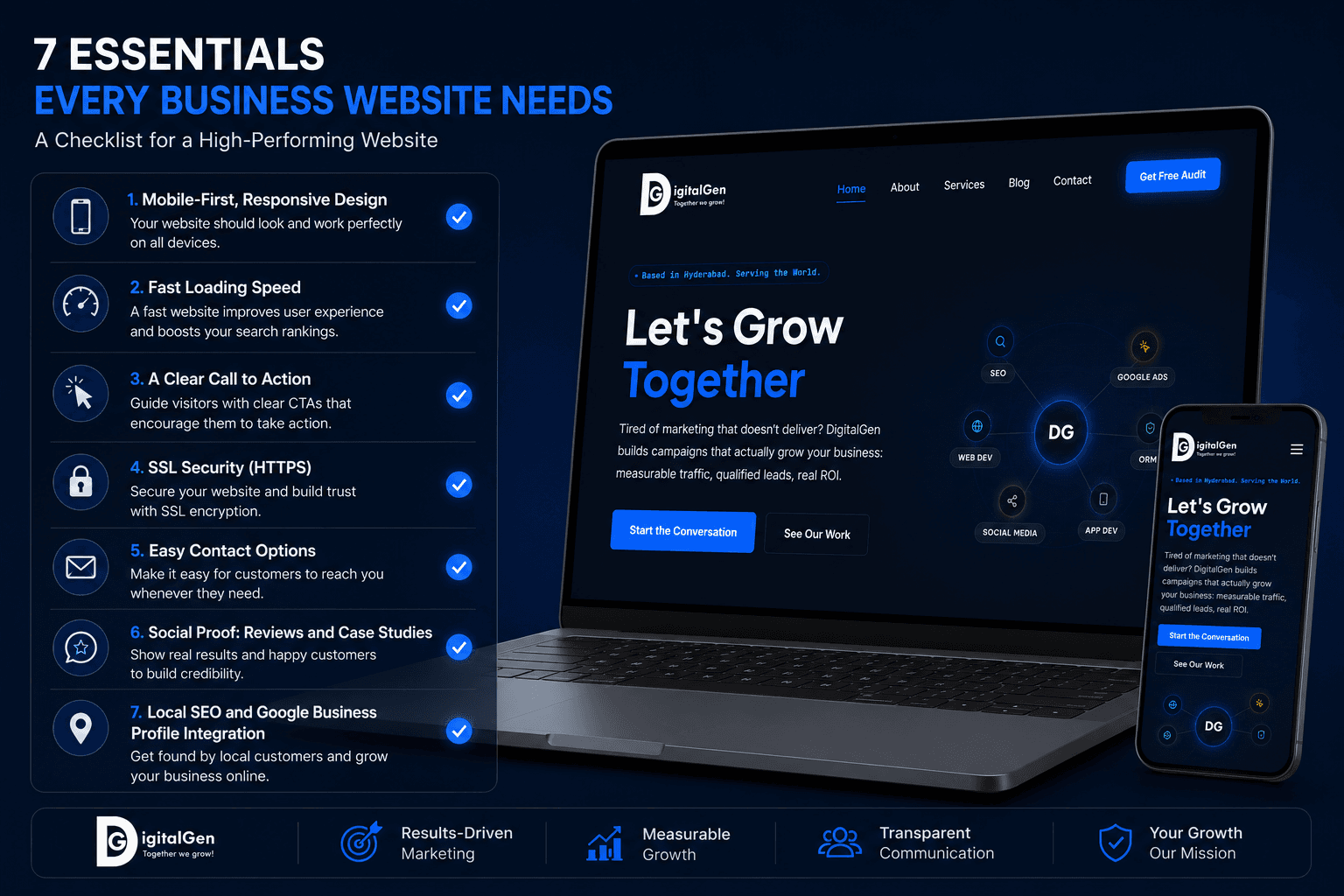
1. Mobile-First, Responsive Design
Mobile devices now account for well over 60 percent of global web traffic, and in India that figure runs even higher, with mobile traffic regularly exceeding 80 percent in a mobile-first market like ours. If your website looks broken, cramped, or hard to tap on a phone, you are failing the majority of your visitors before they even see what you offer.
Google also uses mobile-first indexing, meaning it primarily evaluates your mobile website when deciding how to rank you, not your desktop version. A responsive website design, one that automatically adapts to any screen size, is not optional anymore. It is the baseline.
2. Fast Loading Speed
Speed decides whether a visitor stays long enough to see the rest of your website. Google research shows that as page load time grows from one second to three seconds, the probability of a visitor leaving rises by 32 percent, and 53 percent of mobile visitors abandon a site that takes longer than three seconds to load. We covered this in full detail, including Google’s Core Web Vitals and exactly what makes a website slow, in our guide on how website speed affects your sales.
The short version: aim for your main content to load in under 2.5 seconds, and treat website speed as a business priority, not a technical afterthought.
3. A Clear Call to Action
Every page on your website should tell the visitor exactly what to do next. Call, WhatsApp, book a call, request a quote, whatever the action is, it should be visible, repeated, and impossible to miss. A website with no clear call to action leaves visitors to figure out what to do on their own, and most simply leave instead.
The best-performing business websites repeat the same call to action in the header, partway through the page, and at the bottom, so no matter where a visitor decides to act, the option is right there.
4. SSL Security (HTTPS)
If your website address does not start with https and show a padlock icon, both Google and your visitors notice. HTTPS has been a confirmed Google ranking signal since 2014, and modern browsers actively flag non-secure sites with a warning, which understandably makes visitors hesitate to enter their details or trust the business behind it.
An SSL certificate is inexpensive and, on most modern hosting, free to set up. There is no good reason for a business website to be running without one in 2026.
5. Easy Contact Options
The whole point of a business website is to make it easy for someone ready to buy to reach you. Yet many websites bury their contact details on a separate page, several clicks away. Your phone number, a click-to-call button, and a WhatsApp link should be visible from the moment someone lands on your site, not hidden behind a “Contact Us” page they have to go looking for.
In India specifically, a visible WhatsApp option often converts better than a contact form, since it matches how people already prefer to communicate with local businesses.
7. Local SEO and Google Business Profile Integration
A great website that nobody finds is not doing its job. Around 46 percent of all Google searches now carry local intent, and a properly connected Google Business Profile is what gets local customers to your website in the first place. We explained exactly how the two work together as one funnel in our guide on Google Business Profile and website.
Your website should reflect the same business name, address, and phone number as your Google Business Profile, and should be built with basic SEO fundamentals in place, proper titles, headings, and a fast, indexable structure, so the two work together instead of against each other.
How many of these 7 things does your website actually have?
Most business websites are missing at least two or three of these seven essentials, quietly losing customers every single day without anyone noticing. Our free website audit checks your site against all seven, mobile-friendliness, speed, security, calls to action, contact options, social proof, and local SEO, and shows you exactly where you stand.
Frequently Asked Questions
Related Guides From DigitalGen
Found this useful? Share it with someone who needs it.
6. Social Proof: Reviews and Case Studies
People do not trust a business just because it says it is good. They trust it when other customers say so. Testimonials, reviews, and real case studies with specific results are what turn a browsing visitor into an enquiry. A website with no proof, no client names, no results, is asking for trust it has not earned.
This is exactly what we built into the website for Milling Equips, an industrial engineering client, where showing real proof and clear credibility was the entire point of the redesign. Their own words after launch capture why this matters:
“We recently partnered with DigitalGen to build our website, and the experience was exceptional. The team didn’t just design a website; they took the time to deeply understand our business goals and target audience. The final product is seamless, modern, and built with a strong strategic foundation.”
Milling Equips
If your website’s proof section says “case studies available on request,” that request is a request nobody makes. Put the proof on the page.