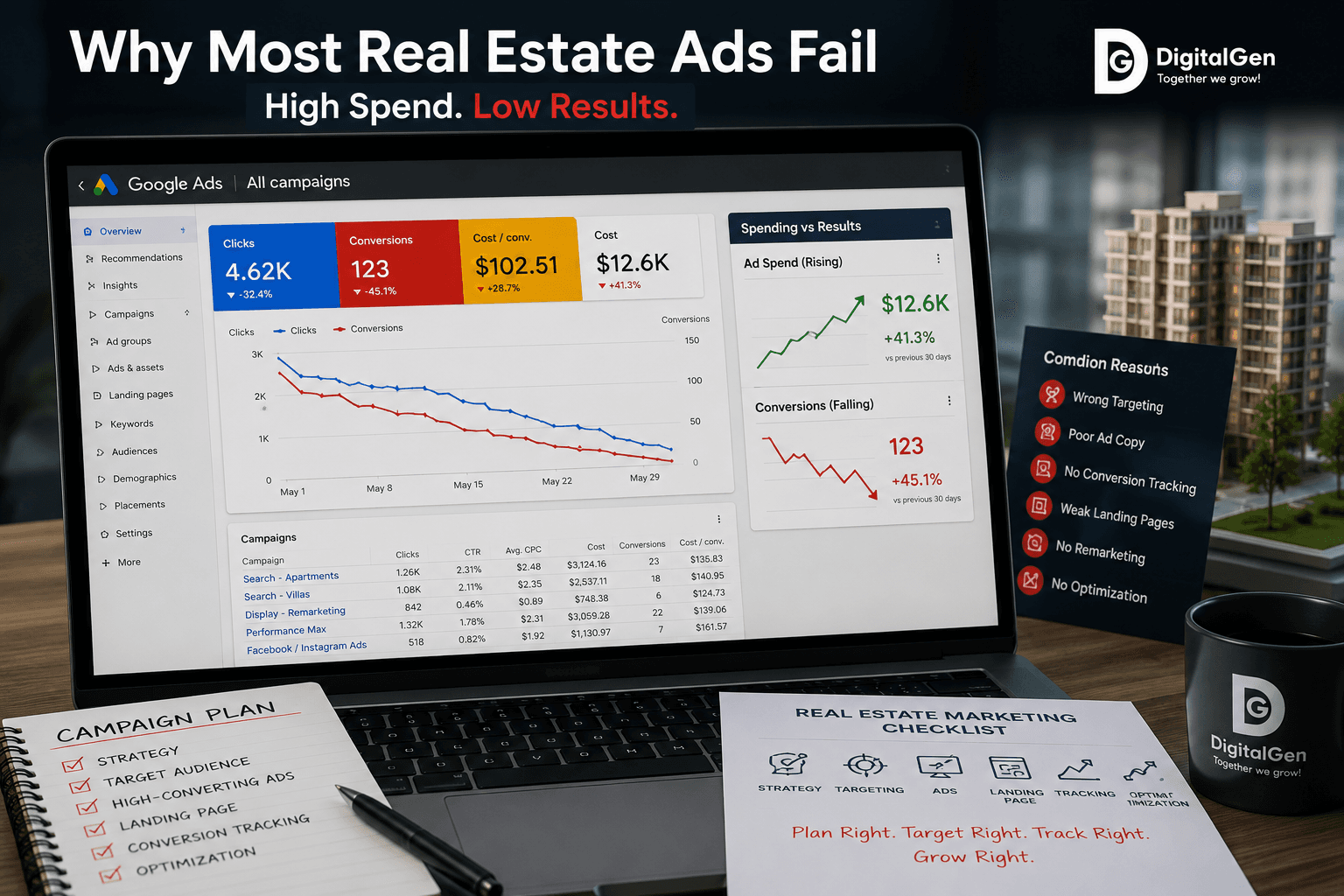
Quick Summary.Real estate posted the largest year-over-year cost-per-click increase of any industry in 2026, up 27.27 percent, while the average cost per lead for real estate now sits at $102.51, well above the $66.69 cross-industry average, according to WordStream’s 2026 Google Ads benchmark report. Rising costs alone don’t explain why so many builder ad campaigns underperform. For anyone running PPC for builders or real estate lead generation, the real cause is usually one of eight specific, fixable mistakes, covered in this guide, not a lack of budget.
Advertising doesn’t fail because digital marketing doesn’t work. It fails because most real estate campaigns are poorly planned, poorly targeted, and never optimised after launch. A builder who spends significant budget on property advertising and gets weak results usually has a strategy problem, not a platform problem. This guide walks through exactly where that strategy typically breaks down, and what a properly run real estate advertising campaign looks like instead.
1. Why Builders Think Digital Advertising Doesn’t Work
A few beliefs come up constantly in conversations with builders who’ve had a bad experience with online advertising, and most of them don’t hold up once you look closer.
"Google Ads don't work for real estate."
Real estate search ads convert at 3.70% on average, and high-intent keywords convert at 8-12%, according to LocalIQ's 2026 real estate benchmark report. Google Ads for real estate works, the targeting and setup usually don't.
"Facebook leads are poor quality."
Meta Ads for real estate often produce leads that look weaker because they're captured earlier in the buyer journey, through interest-based targeting rather than active search intent. That makes them a different kind of lead, not a broken channel.
"Online marketing is too expensive."
Real estate cost per lead does run high, $102.51 on average per WordStream’s 2026 data, but that number reflects a competitive, high-value category, the same category where a single closed deal can be worth lakhs in commission or margin.
"Property portals are enough."
Portals put your listing next to every competitor bidding for the same buyer's attention. Paid advertising you own sends buyers to your website, where you control the story.
"Digital marketing gives instant bookings."
Real estate has one of the longest buying cycles of any category. Expecting a booking within days of launching a campaign sets up disappointment regardless of how good the campaign is.
2. The 8 Mistakes Killing Real Estate Ad Campaigns
MISTAKE 1
Running Campaigns Without a Strategy
A campaign objective decides everything downstream, targeting, creative, even which platform makes sense. Using a Display or Performance Max campaign built for reach when the real goal is qualified enquiries wastes budget on the wrong outcome.
MISTAKE 2
Targeting the Wrong Audience
A campaign targeting all of Hyderabad for a premium 3 BHK project is targeting thousands who will never qualify. Narrowing to specific localities, income-appropriate interest signals, and retargeting past visitors consistently outperforms broad targeting.
MISTAKE 3
Choosing the Wrong Keywords
"3 BHK apartments near ORR" is high-intent. "What is RERA" is informational, poor for a lead-generation ad. Phrase and exact match on specific, high-intent terms, backed by a strong negative keyword list, protects spend for searches that actually convert.
MISTAKE 4
Weak Ad Copy
Generic copy gets ignored, specific copy gets clicked. Strong real estate ad copy names the locality, states the value proposition plainly, and ends with a concrete call to action, book a site visit, not a vague "learn more."
MISTAKE 5
Poor Budget Allocation
Many builders put their entire budget into one platform and leave nothing for retargeting or awareness. A balanced spread across Search, Meta, retargeting, and Display outperforms a single-channel bet.
MISTAKE 6
Ignoring Conversion Tracking
A campaign without tracking is a campaign nobody can actually optimise. Calls, WhatsApp clicks, form submissions, and site visits booked all need to be tracked to calculate real cost per qualified lead.
MISTAKE 7
Not Testing Campaigns
Headlines, creatives, audiences, and landing pages should all be tested against each other on an ongoing basis. A campaign launched once and left alone rarely stays efficient.
MISTAKE 8
Stopping Campaigns Too Early
New campaigns go through a learning phase where the algorithm is still calibrating. Pulling a campaign after five days of "weak" results throws away data the account needs to actually optimise.
“Luxury Apartments Available”
“Premium 3 BHK Apartments Near ORR | Book a Site Visit Today”
A Balanced Monthly Budget Allocation
Google Search
Capture high-intent buyers actively searching
40%
Meta Ads (Facebook/Instagram)
Awareness and interest-based discovery
25%
Retargeting (Google + Meta)
Bring back visitors who didn't convert on first visit
20%
YouTube / Display
Brand awareness, project walkthroughs
10%
Property Portals
Supplementary reach, not primary strategy
5%
3. Google Ads vs Meta Ads for Real Estate
Google Ads is best for capturing active, high-intent searchers, with generally higher lead quality but higher CPC (around $3.22 average for real estate search). Meta Ads builds awareness and discovery earlier in the journey, with a lower cost per impression and very strong retargeting through the Meta Pixel and custom audiences.
Most successful builder campaigns don’t choose one over the other, they use Google Search to capture ready buyers and Meta to build the awareness and retargeting pool that feeds Search over time, often through a combined Google Ads agency and Meta Ads agency relationship rather than splitting the two across separate vendors.
4. Property Portals vs Paid Advertising
MagicBricks, Housing.com, and 99acres offer large existing buyer traffic and are easy to list on, but your listing sits next to every competitor, with limited brand control, and leads are often shared or resold. Portals are useful for supplementary reach, not a replacement for owned property marketing that sends buyers to a website and landing page you fully control.
5. Advertising Metrics Every Builder Should Track
CTR (Click-Through Rate)
How compelling your ad is. Real estate search CTR averages 7.61% (WordStream, 2026)
CPC (Cost Per Click)
What you pay per visitor. Real estate search CPC averages $3.22, up 27.27% year over year
Conversion Rate
The share of clicks that become a lead. Real estate search averages 3.70%
Cost Per Lead (CPL)
Total spend divided by leads generated. Real estate averages $102.51, well above the $66.69 cross-industry average
Cost Per Qualified Lead
Cost per lead that actually matches your buyer profile, the number that matters more than raw CPL
ROAS (Return on Ad Spend)
Revenue generated per rupee spent on ads
Customer Acquisition Cost
Total cost, including team time, to acquire one paying customer
Lead-to-Site-Visit Ratio
How many leads actually convert into a booked site visit
6. What Successful Builders Do Differently
The builders getting consistent results from real estate advertising share a pattern: continuous campaign optimisation instead of a “launch and leave” approach. That means regular performance reporting, creative refreshes before an ad set fatigues, ongoing keyword and audience refinement, active remarketing to past visitors, and decisions driven by data rather than gut feeling.
7. Should You Run Ads In-House or With an Agency?
Some builders run real estate advertising in-house, and for a single, simple campaign that can work. But as budgets grow across Google Ads, Meta Ads, and remarketing simultaneously, most builders eventually look for a real estate marketing agency or performance marketing partner to manage it properly. Good Google Ads management brings ongoing campaign optimisation, proper conversion tracking, and audience refinement as a standard part of the service, not an afterthought, and treats lead generation for builders as an ongoing discipline rather than a one-time setup.
If you’re comparing which digital marketing company to work with for property advertising, the same filters apply as with any advertising agency for builders: ask to see real account performance, ask how they handle customer acquisition cost, not just cost per click, and ask how often they actually test and refine a campaign after launch.
8. Advertising Audit Checklist
Campaign objective matches the actual business goal (leads, not just reach)
Targeting is narrowed to specific localities and buyer income segment
Keyword list uses phrase or exact match on high-intent terms
A negative keyword list is in place and reviewed monthly
Ad copy names the locality, configuration, and a clear call to action
Budget is spread across Search, Meta, and retargeting, not one channel alone
Conversion tracking is set up for calls, WhatsApp, forms, and site visits
Google Analytics 4 and Meta Pixel are both installed and verified
At least two ad creatives and two headlines are being tested against each other
Landing pages match the ad's specific offer, not a generic homepage
Campaigns are given at least 2 weeks before being judged or paused
Cost per qualified lead is reviewed weekly, not just cost per lead
9. A Parallel Worth Noting: Nagpal’s Hyderabad
Every mistake covered in this guide comes down to one idea: a launch that has no anticipation built ahead of it, and no strategy behind the spend, underperforms regardless of budget. That principle isn’t unique to real estate. In our Nagpal’s Hyderabad case study, a restaurant relocating to Sindhi Colony faced the same core challenge a builder faces before a project launch, an audience that could easily be lost in the move, and one shot at making the opening feel like an event rather than a disruption.
Food and beverage and real estate are different categories, but the parallel holds. Rather than relying on paid advertising, DigitalGen built anticipation in the weeks before the move, a personal, on-camera announcement from the owner, a countdown to the new outlet, and a dedicated Grand Inauguration moment, with only very minimal paid support behind it. The result was a strong response on opening day, attributed directly to the visibility and anticipation built before launch, not a last-minute ad push.
The lesson for builders is the same one that worked for Nagpal’s: the weeks before a launch, not just the launch itself, are where the audience is won. Whether that’s a restaurant reopening in a new locality or a project going live, anticipation built in advance consistently outperforms a strategy that only starts once the doors, or the booking form, are open.
Key Takeaways
Real estate ad costs are genuinely rising, but rising cost is not the same as a broken strategy.
Most underperforming campaigns fail due to targeting, keyword, creative, or tracking mistakes, not the platform itself.
Google Ads and Meta Ads play different roles and work best combined, not chosen exclusively.
Conversion tracking is the foundation every other optimisation depends on.
Real estate's long buying cycle means campaigns need weeks, not days, to prove themselves.
Is Your Ad Spend Working as Hard as It Should?
DigitalGen works as a real estate marketing agency managing Google Ads and Meta Ads campaigns for builders and developers, with proper tracking, targeting, and ongoing optimisation built in from day one.
Most failures trace back to one of a handful of fixable issues: unclear campaign objectives, poor audience targeting, weak keyword selection, generic ad copy, unbalanced budget allocation, missing conversion tracking, no ongoing testing, or stopping campaigns before they've had time to optimise.
What is a good cost per lead for real estate advertising?
WordStream's 2026 benchmark puts the average real estate cost per lead at $102.51, notably above the $66.69 cross-industry average, reflecting how competitive and high-value the category is. What matters more than hitting the average is your cost per qualified lead relative to your project's margin.
Should a builder use Google Ads or Meta Ads?
Both, ideally. Google Ads captures buyers who are already actively searching, while Meta Ads builds awareness and powers retargeting. Most successful builder campaigns combine the two rather than relying on just one.
How long should a real estate ad campaign run before judging results?
At least two to three weeks, to move past the platform's initial learning phase, and longer given real estate's naturally long buying cycle. Judging a campaign after a few days rarely reflects its true performance.
Are property portal listings enough on their own?
No. Portals put your listing next to every competitor bidding for the same buyer, and often share or resell the same lead. Owned advertising sends buyers directly to a website and landing page you control.
What should every real estate ad campaign track?
At minimum, calls, WhatsApp clicks, form submissions, and booked site visits, set up through Google Analytics 4, Google Tag Manager, Google Ads conversion tracking, and the Meta Pixel, so cost per lead and cost per qualified lead can actually be measured.
Is Facebook lead quality really worse than Google Ads?
Not inherently worse, just different. Meta leads are typically captured earlier in the buyer journey through interest-based targeting rather than active search, so they often need more nurturing before converting, which is not the same as being poor quality.
How do I find the best digital marketing company for real estate advertising?
Look for a Google Ads agency or digital marketing company that can show real account performance, sets up proper conversion tracking from day one, and treats campaign optimisation as an ongoing process rather than a one-time setup.