Why Your Website and Digital Marketing Should Be Built Together
☰ Table of Contents
- 1. The Business With a Beautiful Website and No Leads
- 2. Why Website and Marketing Projects Drift Apart
- 3. The Customer Journey Is One System
- 4. The Shared Brief: What Developers and Marketers Should Agree On
- 5. Build Pages Around Search Intent, Not Design Alone
- 6. What a Marketing-Ready Website Actually Means
- 7. Landing Pages: Where Ads and Development Meet
- 8. Speed Matters, But Don't Treat It as a Separate Project
- 9. SEO Needs to Influence the Build
- 10. Tracking Should Exist Before the First Campaign
- 11. What Breaks When Redesign and Marketing Are Not Coordinated
- 12. A Practical Example: redBus
- 13. The DigitalGen Website + Marketing Alignment Framework
- 14. How to Tell If Your Website and Marketing Are Misaligned
- 15. Free Website + Digital Marketing Alignment Scorecard
- 16. Frequently Asked Questions
1. The Business With a Beautiful Website and No Leads
A business relaunches its website. It looks sharper, the brand finally feels current and the owner is proud to send prospects the new URL. Three months later, the marketing team is still trying to make the new site convert. Some old pages disappeared. Campaigns point to generic pages. The enquiry form is buried. Organic traffic has changed. Nobody can clearly explain which pages generate qualified enquiries.
The problem is not that the website is bad or that the marketing team is bad. The problem is that the two were planned as separate projects. The developer was given a design brief. The marketer was given a traffic target. Neither was given the same commercial map.
Marketing brings the right people to the door. The website has to make it easy for them to walk in.
2. Why Website and Marketing Projects Drift Apart
The split is understandable. Website development feels like a project with a start and finish; SEO, Google Ads and social media feel like ongoing services. Businesses therefore hire a developer first and an agency later, or run ads against a website that was never designed around the search terms, offers and conversions the campaigns need.
That sequence creates avoidable work. A marketing team may discover that an important service has no dedicated page, a campaign needs a landing page that does not exist, URLs need to change, or tracking was never considered. At that point, marketing is working around development decisions instead of influencing them.
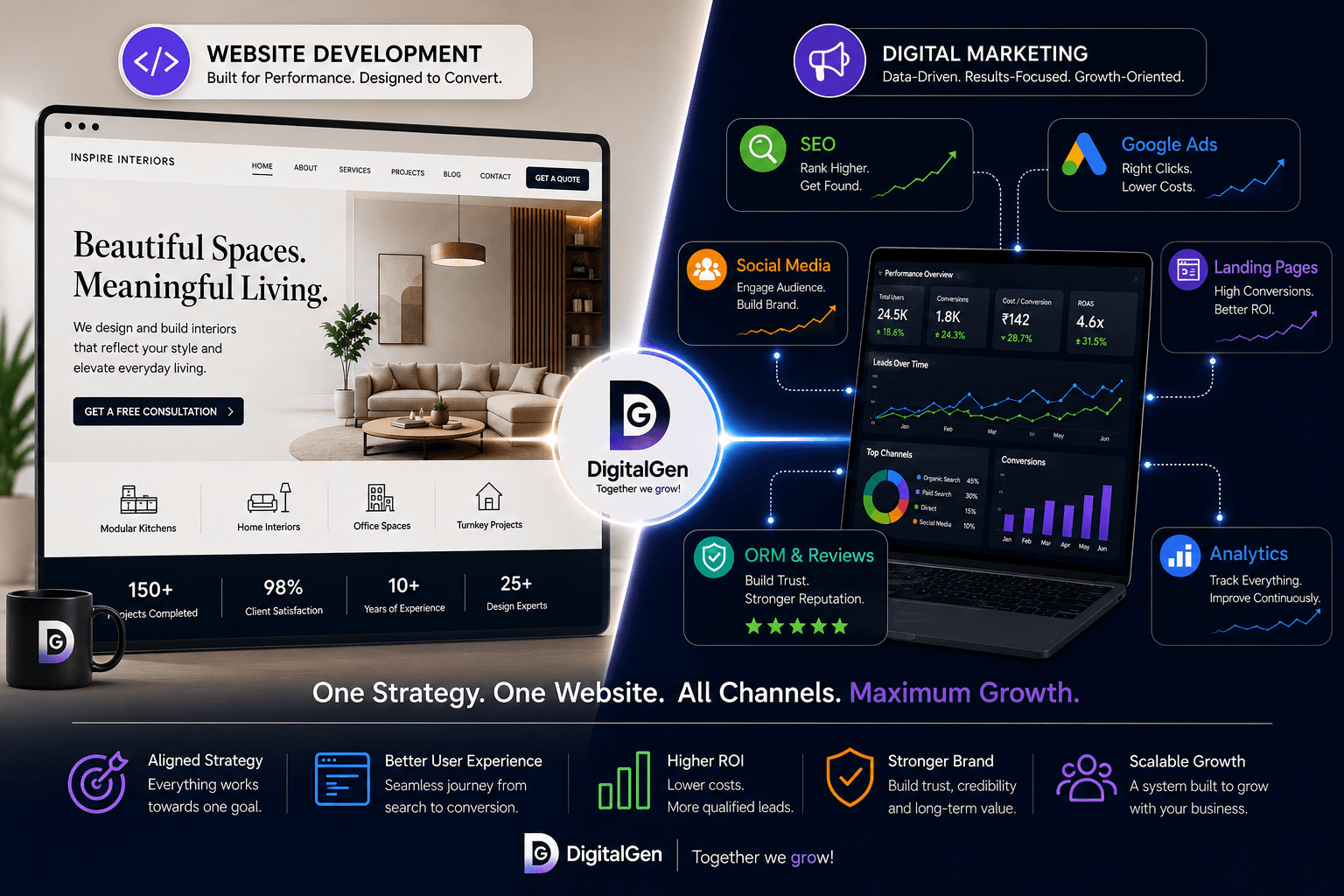
DigitalGen’s current service model treats channels as connected: its services page describes SEO, Google Ads, web development, social media, ORM and content as parts of an integrated strategy rather than isolated silos. See DigitalGen’s integrated services.
3. The Customer Journey Is One System
A typical commercial journey looks simple:
But every arrow hides a development or marketing decision. A well-targeted Google Ad is wasted if the landing page is slow or irrelevant. An SEO page can rank and still fail if the visitor cannot understand the offer or find the next step. A beautiful project page is less useful if it cannot be discovered through search or connected to a service page.
This is why website development and digital marketing should be discussed together even when separate specialists are involved. The customer does not experience your business as separate departments. They experience one journey.
5. Build Pages Around Search Intent, Not Design Alone
A marketing-ready site does not start with a template. It starts with the jobs each page needs to do. A service page should answer the searcher’s need, establish credibility and make the next action obvious. A location page should demonstrate local relevance rather than simply repeat a city name. A project page should show evidence, not just images.
For example, a business targeting a search such as “digital marketing company in Hyderabad” needs a page that communicates local relevance, services, proof and contact options. A page built for a different intent, such as someone researching how digital marketing works, needs a different structure. Keyword research therefore affects information architecture, not just meta titles.
6. What a Marketing-Ready Website Actually Means
DigitalGen’s web development service describes its websites as fast, mobile-first and conversion-optimised. Explore DigitalGen Web Development.
7. Landing Pages: Where Ads and Development Meet
A paid campaign should not automatically send every visitor to the homepage. Someone searching for a specific service has already revealed intent; the destination page should continue that conversation. Google defines a landing page as the webpage people reach after clicking an ad and notes that landing-page experience is one of the components used in Quality Score.
The practical implication is simple: the ad, keyword and landing page should make sense together. If an ad promises a specific service but the visitor lands on a generic homepage with several competing actions, the business has created friction before the sales conversation even begins.
DigitalGen’s Google Ads service includes landing-page advice and conversion tracking, reinforcing why the page behind the ad should be part of campaign planning rather than treated as a separate web task. See DigitalGen Google Ads Services.
8. Speed Matters, But Don’t Treat It as a Separate Project
Performance is one of the clearest examples of development affecting marketing. Image choices, scripts, hosting, code and interaction design can influence the experience visitors get after an SEO result or ad click. That is why performance should be part of the build brief, not a cleanup task months later.
DigitalGen already has a dedicated article covering Core Web Vitals and the business impact of speed. Rather than repeating it here, go deeper into the technical topic: How Website Speed Quietly Kills Your Sales. This creates a cleaner content cluster: this article owns website + marketing alignment, while the existing article owns Core Web Vitals and performance.
9. SEO Needs to Influence the Build
SEO is often described as something added after a website is launched: optimise titles, add keywords and publish blogs. A stronger approach is to let SEO influence the site’s architecture from the beginning.
For ongoing organic growth, DigitalGen’s SEO service can then work on technical SEO, keyword targeting, content and optimisation without fighting the site’s underlying structure. Explore DigitalGen SEO Services.
10. Tracking Should Exist Before the First Campaign
One of the most expensive questions in marketing is also one of the simplest: which page, campaign or channel actually generated this customer? If tracking is added only after campaigns launch, the business may have a gap in the data exactly when it needs to make decisions.
At minimum, the build should account for form submissions, calls, WhatsApp clicks, consultation bookings and other meaningful conversion events. DigitalGen’s Google Ads service describes conversion tracking for calls, forms, WhatsApp clicks and purchases, the right principle is to measure the action, not just the visit. DigitalGen Google Ads Management.
11. What Breaks When Redesign and Marketing Are Not Coordinated
None of these failures requires a better ad campaign by itself. They require the development and marketing plan to be treated as one system.
12. A Practical Example: redBus
A useful example comes from Google’s own web.dev case study on redBus. The company improved Interaction to Next Paint (INP), a Core Web Vital focused on responsiveness, and the case study reports a 7% increase in sales. The example is valuable because the improvement came from the user experience and technical side of the product rather than from simply increasing advertising spend.
The lesson for a service business is not that every performance improvement will produce a 7% sales increase. It is that development decisions can affect commercial outcomes. That is exactly why marketing should have a seat at the table before the build is finished.
13. The DigitalGen Website + Marketing Alignment Framework
This does not mean one agency must control every digital activity. It means someone must own the alignment. DigitalGen’s own operating model follows discovery, audit, strategy/execution and measurement, a structure designed to keep channels moving toward the same business goal. See DigitalGen’s full service approach.
14. How to Tell If Your Website and Marketing Are Misaligned
If several answers are uncomfortable, the answer may not be another isolated marketing campaign. Start with an alignment audit.
15. Free Website + Digital Marketing Alignment Scorecard
Score your website across structure, SEO, conversion, landing pages, performance, tracking and process. Then send your score to DigitalGen for a free review.
Suggested Score Bands
Want Us to Review Your Score?
Send it to DigitalGen and we’ll help you understand which areas deserve attention first.
16. Frequently Asked Questions
Related Guides From DigitalGen
Found this useful? Share it with someone who needs it.